

Why Precision Matters More Than Ever in Modern Manufacturing
High precision assembly is the process of joining components with extremely tight tolerances—typically less than one millimeter, often reaching micrometer or even sub-micrometer accuracy. When every micron matters, even the smallest misalignment can lead to product failure, regulatory violations, or massive scrap costs.
What You Need to Know About High Precision Assembly:
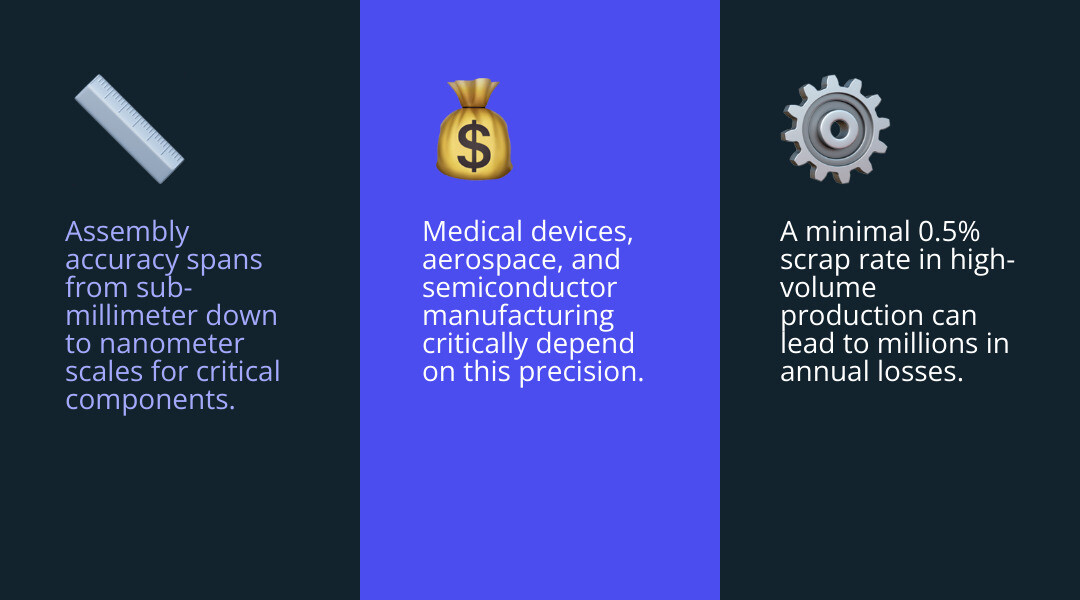
- Tolerance Levels: Components are assembled with accuracy ranging from sub-millimeter (under 1mm) down to micrometer (1 µm = 0.001mm) or even nanometer scales
- Critical Industries: Medical devices, aerospace, semiconductors, and automotive advanced systems depend on this level of precision
- Cost Impact: A scrap rate of just 0.5% in high-volume environments can mean millions of dollars in lost product annually
- Key Technologies: Vision-guided systems, active alignment, force-torque sensing, and specialized robotics enable micrometer-level positioning
- Quality Control: In-process and end-of-line testing are non-negotiable for catching issues before they escalate
In automation, precision isn’t just a technical specification—it’s imperative to succeed. The tighter your tolerances drop, the faster your margin for error disappears. A medical implant that’s off by just a few micrometers can fail. An aerospace component with slight misalignment can compromise an entire system. Electronics assemblies require positioning accuracy of 1 µm for reliable performance.
The challenges multiply with speed. Scaling high-volume precision assembly exponentially increases complexity, requiring management of tolerance stack-up, miniaturized components, and rigorous quality standards for every unit.
This guide breaks down everything you need to understand about high precision assembly: the industries that depend on it, the core challenges manufacturers face, the technologies that make it possible, and how to choose the right partner for success.
The Critical Role of Precision Assembly Across Industries
High precision assembly isn’t just a technical achievement—it’s the foundation that makes modern technology possible. Across industries from operating rooms to outer space, the ability to consistently join components with micrometer-level accuracy separates breakthrough innovations from expensive failures.
Let’s look at where this precision matters most.
Medical & Healthcare
In medical devices, precision is a matter of life and death. For a surgical robot, a deviation of just a few micrometers can mean the difference between success and serious complications.
Diagnostic devices analyzing samples at the cellular level demand the same exacting standards. And active implants—pacemakers keeping hearts beating, neurostimulators managing chronic pain—require not only micron-level accuracy during assembly but also flawless long-term reliability once implanted in patients.
The stakes are simply too high for anything less than perfection. That’s why precision medical device production with advanced equipment focuses on creating assembly processes that can meet these uncompromising standards. It’s a core part of our work in medical and healthcare manufacturing.
Aerospace & Defense
In aerospace and defense, there is zero margin for error. High precision assembly ensures systems work flawlessly in extreme environments, from components orbiting in space to aircraft traveling at high speeds. Satellite components, guidance systems, and the intricate internal mechanisms of turbine engines all demand tolerances measured in micrometers, where the slightest misalignment can cascade into catastrophic failure.
Automated precision machining improves aerospace quality and performance by bringing consistency and repeatability that manual processes simply can’t match. That’s why aerospace remains one of the most demanding—and rewarding—sectors for precision manufacturing.
Electronics & Semiconductors
The electronics industry has been in an arms race with itself for decades, cramming more functionality into smaller spaces every year. This relentless miniaturization pushes precision requirements to almost unbelievable levels.
Microchip integration happens at scales where components are measured in micrometers. LiDAR systems for autonomous vehicles require optical alignment accurate to within a few microns. Fiber optic assemblies for high-speed data transmission demand similar precision—a misalignment invisible to the naked eye can degrade signal quality dramatically.
And at the cutting edge? The mirrors in extreme ultraviolet (EUV) lithography systems need wavefront accuracy of just 0.1 nanometers. That’s roughly the width of a single atom. These requirements drive innovation in communications manufacturing, where precision enables the data infrastructure we all depend on.
Automotive
The automotive industry has undergone a dramatic change. Modern vehicles aren’t just mechanical systems anymore—they’re sophisticated electronics platforms on wheels.
Advanced driver-assistance systems (ADAS) rely on precisely integrated sensors and cameras working together. A camera mounted just a degree off-axis or a radar sensor misaligned by a millimeter can compromise the entire safety system.
Electric vehicle battery assemblies present their own challenges. Individual cells must be positioned and connected with tight tolerances for optimal performance and safety. Any misalignment can create hot spots, reduce capacity, or in extreme cases, pose safety risks.
Even in the automotive aftermarket, precision matters. Replacement parts need to meet the same exacting standards as original equipment to ensure vehicle safety and performance.
The common thread across all these industries? High precision assembly isn’t a luxury—it’s the baseline requirement for products that work reliably in the real world.
Overcoming the Core Challenges of Micrometer-Level Accuracy
Achieving micrometer-level accuracy is a constant battle against physics and equipment limitations. At scales where a human hair looks like a tree trunk, every aspect of the process becomes exponentially more complex.
The core challenges break down into three main areas that every manufacturer must wrestle with: handling components so small you can barely see them, maintaining accuracy when production speeds ramp up, and managing the sneaky problem of cumulative errors across multiple parts. Miss any one of these, and you’re looking at scrap rates that can sink a project.
The Miniaturization Dilemma: Handling Microscopic Components
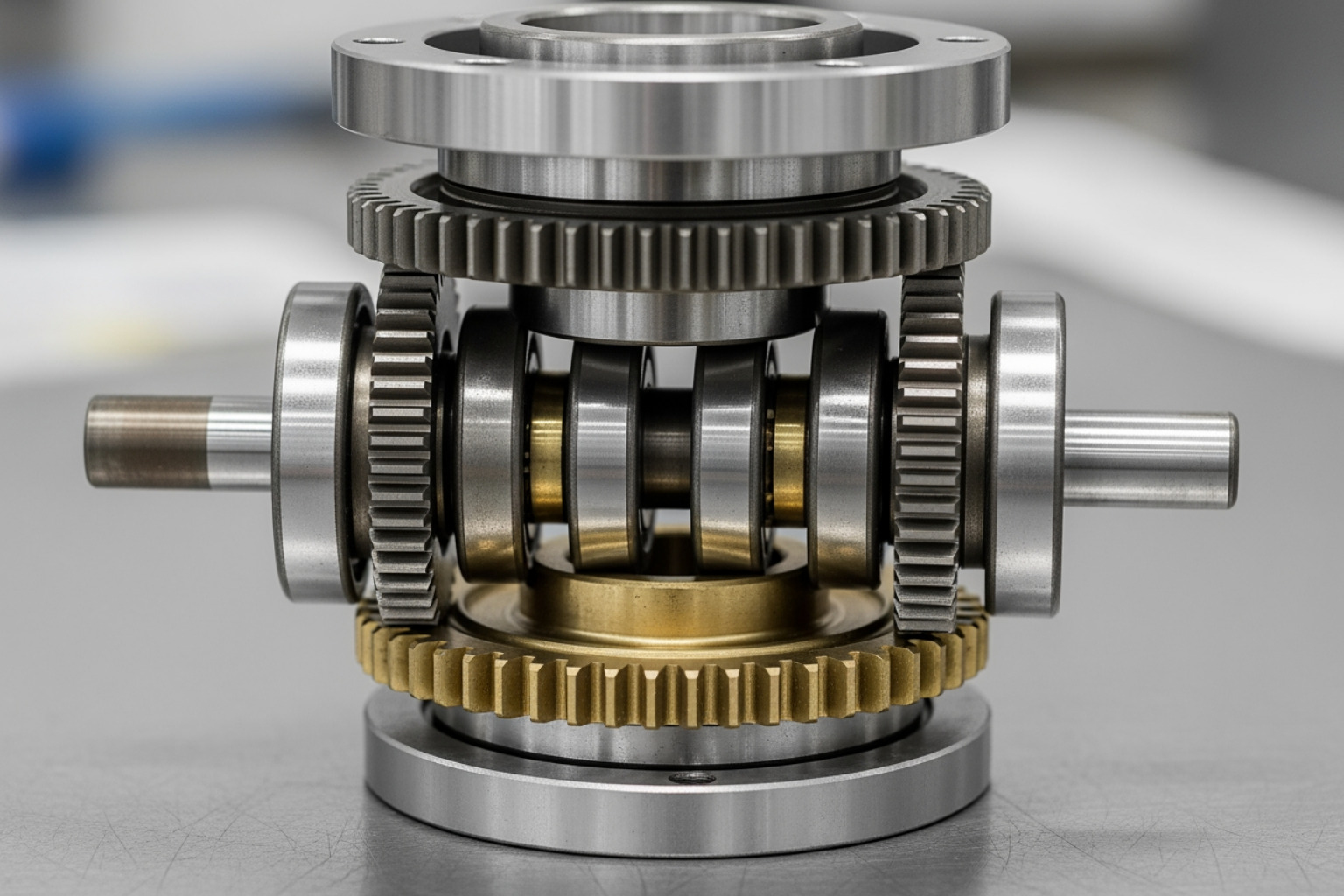
Modern technology’s trend toward miniaturization creates major headaches for manufacturers. Gripping and positioning a component just a few micrometers wide is like trying to thread a needle with boxing gloves using a standard robotic gripper.
Micro-optic fibers and microchips are particularly unforgiving. These components aren’t just small—they’re incredibly fragile. Apply even slightly too much pressure, and you’ve just created expensive scrap. This sensitivity demands specialized end-effectors and micromanipulators designed specifically for these delicate tasks.
The real challenge is that conventional assembly techniques simply don’t scale down. What works beautifully for assembling larger components becomes completely impractical at the micro scale. Everything from singularization (separating individual parts) to magazining (storing and feeding parts) to basic transport requires rethinking from the ground up.
The Speed vs. Accuracy Trade-off
Anyone can achieve high accuracy if they’re willing to work slowly enough. The real challenge in high precision assembly comes when you need both speed and accuracy—which is exactly what high-volume production demands.
At low speeds, you can achieve remarkable consistency with the right equipment. Specialized tooling, fine motor actuators, and careful process control make it possible. But production volumes don’t wait for perfection to happen slowly.
When you scale up to high speeds, everything changes. Now you’re dealing with vibration from rapid movements, heat generation from continuous operation, and dynamic forces that can throw off even the most carefully calibrated system. A tiny tremor or a microsecond delay—things that wouldn’t matter at slower speeds—can cause misalignment at high throughput rates.
The complexity doesn’t just increase linearly with speed; it explodes exponentially. This is precisely why The Impact of Automation on Scaling High-Volume Production requires such careful consideration. You can’t just run the same process faster and expect the same results.
Managing Tolerance Stack-Up in Multi-Part Assemblies
Of all the challenges in precision assembly, tolerance stack-up might be the most insidious because it sneaks up on you. Here’s how it works: imagine you’re assembling five components, each with a tolerance of ±0.01 mm. That seems reasonable, right? Each part is well within spec.
But here’s the catch—those tolerances are cumulative. In the worst-case scenario, all those tiny variations could add up to ±0.05 mm in the final assembly. For a high precision assembly, that kind of deviation can mean complete product failure, even though every single component was technically “good.”
This is where Design for Manufacturing (DFM) becomes critical. You can’t wait until parts are on the production floor to think about how tolerances interact. Smart DFM means carefully defining tolerances for each component while considering how they’ll stack up in the final assembly. Understanding Precision CNC Machining Tolerances is your first line of defense against stack-up issues.
But design is only part of the solution. On the production side, you need adaptive systems and flexible fixturing that can accommodate slight variations without creating stress or misalignment. In-process testing catches problems before they compound, and adaptive systems can compensate for minor variations in real-time. Think of it as building intelligence into the process itself—systems that can adjust on the fly rather than rigidly following a path that might not account for real-world variation.
Technologies and Techniques for High Precision Assembly
Achieving micrometer-level accuracy in production requires a combination of sophisticated equipment, intelligent systems, and proven techniques. At Staub, our investment in Automated Manufacturing brings these technologies together to deliver the precision our clients demand.
Foundational Equipment for High Precision Assembly
The foundation of any high precision assembly operation starts with the right equipment. These are specialized systems engineered for extraordinary accuracy and consistency.
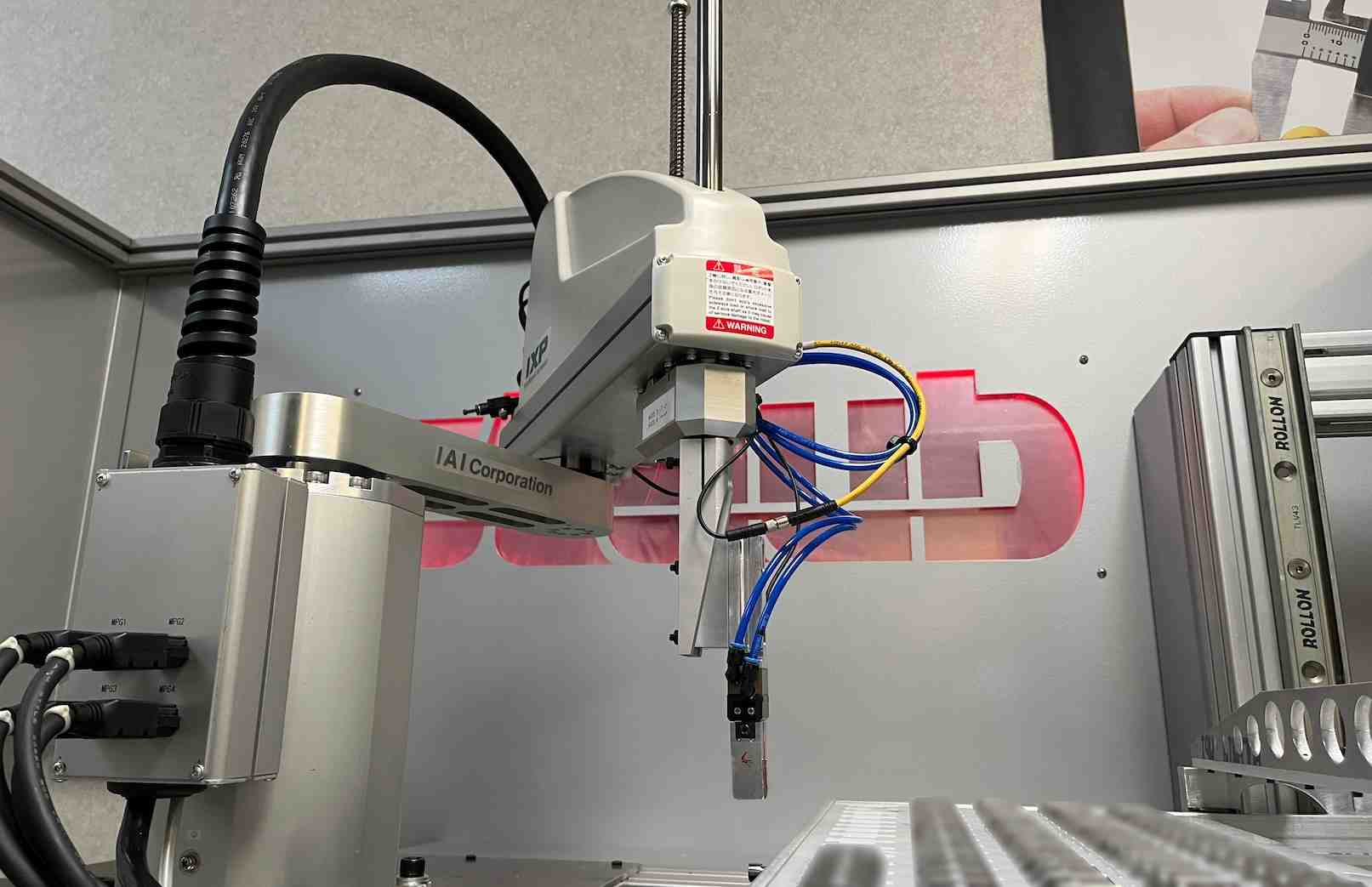
High-precision robotics form the backbone of modern precision assembly. While standard 6-axis industrial robots are common, achieving true micrometer-level accuracy requires robots improved with advanced sensors and sophisticated control systems. These aren’t off-the-shelf solutions; they’re carefully selected and often customized for specific applications.
Precision motion control is where the rubber meets the road. The systems we use can position components with bidirectional repeatability of 0.3 µm and positional accuracy of 1 µm. To put that in perspective, some mechanical actuators in our facility achieve positional accuracy within 0.0003 inches. This level of control requires highly stable platforms, advanced actuators, and environmental controls that minimize vibration and thermal expansion.
Hexapods might sound like something from a science fiction movie, but they’re invaluable for optical alignment and other applications requiring ultra-fine adjustment. These six-axis parallel manipulators can move and adjust components in all degrees of freedom at the micrometer or sub-micrometer level—perfect for when you need to tweak position, angle, and orientation simultaneously.
Specialized end-effectors complete the picture. Think of these as the “hands” that actually touch your components. Standard grippers won’t cut it for high precision assembly. We use custom-designed vacuum tools, magnetic manipulators, and delicate grippers engineered specifically for handling miniaturized and fragile components without causing damage or contamination.
Advanced Techniques for Adaptive Assembly
Beyond equipment, the breakthrough is adding intelligent sensing and adaptive techniques that respond to real-world variations. These technologies transform rigid motions into smart, responsive systems.
Vision-guided systems have revolutionized precision assembly. High-resolution cameras paired with advanced image processing algorithms can detect minute component features, assess position and orientation down to the micron level, and guide robotic movements in real-time. They don’t just ensure accurate placement—they also inspect for defects and provide immediate feedback for adjustments. It’s like giving your assembly system a set of incredibly precise eyes.
Active alignment takes this concept even further, especially in optical assemblies. Instead of relying purely on mechanical positioning, active alignment adjusts components based on real-time performance feedback—things like image quality or signal strength. The system actively optimizes component position to achieve the best functional performance. This approach allows for higher yields and better product performance, even when individual components have slightly looser tolerances. According to Precision Assembly and Application Technologies – Fraunhofer IPA, this technique is essential for cost-effective precision manufacturing.
Micromanipulation becomes essential when you’re working with components in the micrometer and sub-micrometer range. These techniques allow for extremely fine adjustments and handling that would be impossible with conventional tools. The challenge isn’t just moving something small—it’s gripping and positioning it precisely without causing damage.
Force-torque sensing adds another layer of intelligence. Sensors in robot wrists or grippers provide real-time force feedback during assembly. This is critical for inserting delicate components with tight tolerances, preventing damage from too much force or incomplete assembly from too little. Force-torque sensing ensures the correct force is applied every time.
Precision adhesive dispensing rounds out our advanced techniques. Many high precision assembly tasks require bonding components with adhesives, and sloppy adhesive application can ruin an otherwise perfect assembly. Our advanced dispensing systems can apply volumes ranging from picoliters to milliliters with extreme accuracy, ensuring optimal bonding without excess material that could interfere with functionality or contaminate sensitive areas.
These technologies and techniques don’t work in isolation—they work together as an integrated system. That’s what makes modern high-precision assembly possible at scale.
Ensuring Success: Quality Control and Strategic Partnerships
Achieving high precision assembly is only half the battle; ensuring every unit meets spec is the other. This requires risk mitigation, process validation, and strategic collaboration, which become critical from day one, often starting with smart DFMA Design for Manufacturing & Assembly.
The Non-Negotiable Role of Quality Control
Without rigorous quality control, even a sophisticated assembly process is a gamble. In high precision assembly, quality checks are non-negotiable. They prevent bad parts from being made and ensure every unit performs as intended.
Think about the financial impact. 0.5% scrap rate we mentioned earlier? In high-volume production, that’s potentially millions of dollars walking out the door every year. Effective quality control doesn’t just protect your reputation—it directly protects your bottom line.
In regulated industries like medical devices and aerospace, the stakes get even higher. Components must perform flawlessly, not just most of the time, but every single time. A pacemaker that’s off by a few micrometers isn’t just a defect—it’s a potential safety issue. Quality control ensures that every assembled unit meets both functional specifications and the stringent safety standards these industries demand.
In-process testing is where smart manufacturers catch issues early, when they’re still manageable and affordable to fix. Vision systems provide automated optical inspection, checking for component presence, proper orientation, and detecting subtle defects that human eyes might miss. Force monitoring verifies correct insertion forces during assembly—too much force might damage a delicate component, while too little might indicate an improper fit. For critical joins, laser weld monitoring ensures weld integrity. Hermetically sealed medical devices and fluidic systems require leak and pressure testing to confirm their seals. And for electronic assemblies, electrical testing verifies circuit continuity and functionality before the unit moves forward.
End-of-line (EOL) testing serves as your final safeguard. This comprehensive check of the finished product often replicates real-world operating conditions to confirm overall performance, reliability, and adherence to every specification. It’s your last chance to catch anything that slipped through earlier checks. Our comprehensive Quality Inspection protocols cover both in-process and end-of-line testing, ensuring nothing leaves our facility unless it’s perfect.
The Value of an Expert Automation Partner
Developing and implementing high-precision assembly systems isn’t something you want to figure out through trial and error. It’s a specialized undertaking that benefits enormously from partnering with an experienced automation provider. The right partner doesn’t just reduce risk—they accelerate development, optimize your design, and help ensure your project succeeds the first time.
An expert partner brings DFM expertise to the table, providing crucial guidance on optimizing your product design for automated, high-precision manufacturing. They understand how small design changes can dramatically improve manufacturability and reduce costs. Their simulation capabilities allow them to model assembly processes digitally, identifying potential issues and optimizing parameters before any physical hardware gets built. This saves tremendous time and money by catching problems in the virtual world rather than finding them on the production floor.
They also provide access to digital tools—a suite of manufacturing intelligence systems that deliver real-time data, process insights, and predictive analytics to maintain precision and efficiency throughout production. And if you’re working in medical, aerospace, or defense applications, their experience in regulated industries becomes non-negotiable. Understanding strict regulatory requirements like AS9100 certification or ITAR compliance isn’t something you can learn on the fly.
When you’re Looking for a Contract Manufacturing Partner for Your Next Project?, asking the right questions makes all the difference. What’s their demonstrated track record in high precision assembly for your specific industry? How do they manage tolerance stack-up in multi-part assemblies? What risk mitigation strategies do they employ throughout the entire project lifecycle? Can they show you concrete examples of their DFM expertise and simulation capabilities? And critically, what ongoing support and training do they offer once the system is implemented? Your production doesn’t stop when the equipment arrives, and neither should their support.
Mitigating Risk with Proof of Principle (POP) Testing
Proof of Principle (POP) testing is an early-stage validation process that proves a concept works before committing resources to full-scale production. It’s a dress rehearsal to find issues early.
POP testing provides concept validation, confirming that your complex or novel assembly process can actually achieve the required precision. It’s surprisingly common for processes that look perfect on paper to reveal unexpected challenges in practice. This testing phase allows for process optimization, where you fine-tune tooling, adjust parameters, and refine sequences until everything works smoothly. You’ll also identify critical quality checks and determine exactly where they need to happen in your assembly sequence.
The financial benefits are substantial. By validating the process with smaller batches, POP testing dramatically reduces material waste and eliminates the costly rework that happens when issues surface after you’ve already built expensive tooling and started production. The cost savings from getting it right the first time—rather than finding fundamental problems after you’ve invested in full-scale equipment—often pay for the POP testing many times over.
At Staub Precision Machine, we’ve seen countless projects where POP testing revealed insights that fundamentally improved the final production system. It’s not an optional step—it’s the foundation of success in high precision assembly.
The Future of Precision Assembly Technology
The world of high precision assembly never stands still, with constant innovations pushing the boundaries of what’s possible. Today’s micrometer-level accuracy is just the beginning.
The driving forces behind these advances are familiar: we want products that are smaller, smarter, more reliable, and more affordable. But the technologies emerging to meet these demands are nothing short of revolutionary. From robots that teach themselves to factories that predict problems before they happen, the future of precision manufacturing is being written right now.
Emerging Trends in High Precision Assembly
One exciting development is integrating Deep Reinforcement Learning (DRL) into assembly systems. Instead of being explicitly programmed, the robot learns through trial and error. It attempts a task, receives feedback, and gradually develops the best approach. This creates adaptive systems that handle variations and improve their own precision without constant human reprogramming.
Predictive maintenance is another game-changer that’s already changing how we think about equipment reliability. By combining artificial intelligence with IoT sensors throughout an assembly line, we can now predict when a component will fail—often weeks before it actually happens. A bearing that’s starting to wear? The system detects the subtle vibration changes. A gripper that’s losing its calibration? The force sensors catch the drift. This means we can schedule maintenance during planned downtime, preventing the costly surprises that disrupt production and compromise precision. As discussed in The Future of Automated Precision Machining: Trends and Predictions, these intelligent systems are becoming essential.
The rise of hybrid manufacturing represents a fundamental shift in how we create precision components. By seamlessly integrating additive manufacturing (3D printing) with traditional subtractive processes like ultraprecision cutting and grinding, we can now produce parts with geometries that were previously impossible. Imagine printing a complex internal structure, then using nanometer-level polishing to achieve optical-quality surfaces on critical areas.
The Push Towards Greater Automation
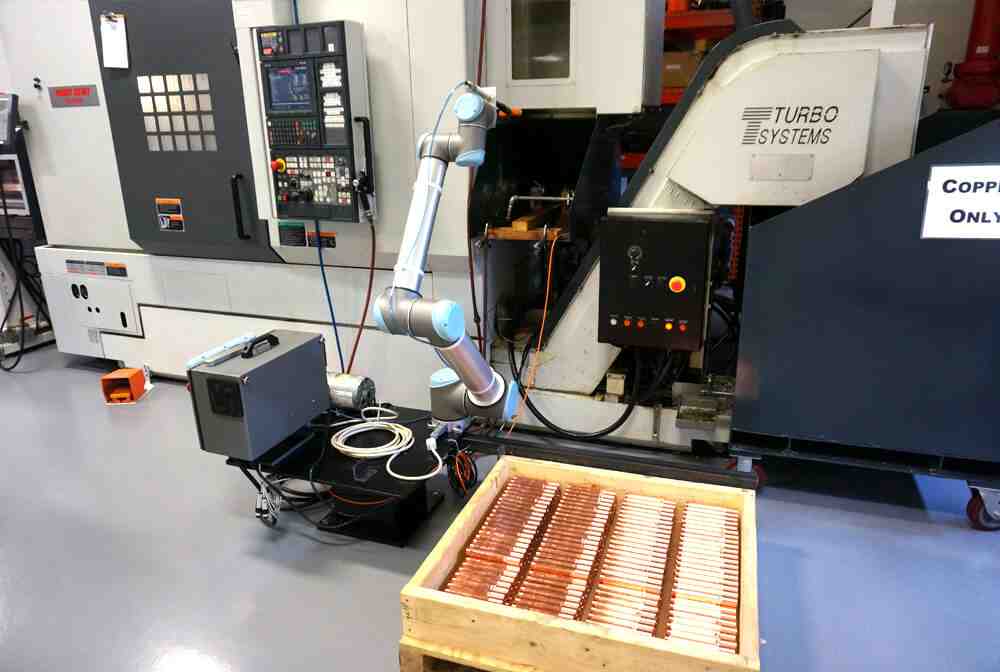
The trajectory is clear: manufacturing is becoming increasingly automated, more intelligent, and more interconnected. This isn’t about replacing people for the sake of it—it’s about achieving levels of consistency and precision that humans simply can’t maintain over thousands or millions of repetitive operations.
“Lights-out” manufacturing is no longer science fiction. These are factories that run with minimal or no human presence, especially during nights and weekends. For high precision assembly, this makes perfect sense. Robots don’t get tired, they don’t lose focus, and they maintain the same micrometer-level accuracy on the millionth part as they did on the first. The result is maximum efficiency and the kind of consistency that regulated industries demand.
The evolution toward smart factories takes automation even further. In these environments, every machine, sensor, and system communicates with every other. Real-time data flows through the entire operation, enabling AI-driven decision-making that optimizes everything from tool paths to production schedules. When a vision system detects a slight drift in component positioning, the system automatically adjusts. When demand patterns shift, production priorities rebalance on the fly.
At the heart of all this is data-driven process optimization. Every movement, every measurement, every assembly result becomes data that the system learns from. Over time, this creates a continuously improving operation that identifies bottlenecks you didn’t know existed and solves problems before they impact quality. This level of insight leads to increased efficiency and repeatability—exactly what you need when every product must meet exacting specifications without exception.
Our commitment to In-House Custom Automated Manufacturing: 6 Benefits You Should Know About means we’re not just watching these trends from the sidelines. We’re actively implementing them, refining them, and using them to deliver the precision our customers depend on. The future of precision assembly is arriving faster than most people realize, and we’re ready for it.
Conclusion
If there’s one thing that’s clear about high precision assembly, it’s this: it’s not just another manufacturing process. It’s the backbone of modern innovation. From the medical devices that save lives to the satellites orbiting overhead, precision at the micrometer and sub-micrometer level makes it all possible.
The path to achieving this level of accuracy isn’t easy. We’ve explored the real challenges manufacturers face—handling components smaller than a human hair, balancing the need for speed with unforgiving accuracy requirements, and managing the cumulative errors that can derail even the most carefully planned assembly. These aren’t theoretical problems. They’re daily realities for companies pushing the boundaries of what’s possible.
But here’s the good news: these challenges have solutions. Advanced technologies like vision-guided robotics, active alignment systems, and specialized micromanipulation tools are changing what we can achieve. Rigorous quality control—both during assembly and at the end of the line—catches issues before they become costly failures. And the future looks even brighter, with artificial intelligence, machine learning, and hybrid manufacturing techniques promising to open up new levels of precision and efficiency.
Perhaps most importantly, success in high-precision assembly isn’t just about having the right equipment. It’s about having the right partner—someone who understands that every micron truly does matter, who brings deep expertise in Design for Manufacturing, and who can guide you from concept through to full-scale production with proven risk mitigation strategies.
At Staub Precision Machine, Inc., we’ve built our reputation on exactly these principles. Our AS9100-certified facility, advanced automation capabilities, and commitment to long-term partnerships mean we’re not just a vendor—we’re an extension of your team. We’ve tackled the toughest precision challenges across aerospace, medical, and defense applications, and we’re ready to help you achieve your most ambitious manufacturing goals. Learn how our advanced automation capabilities can support your next aerospace project.